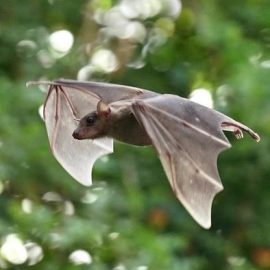
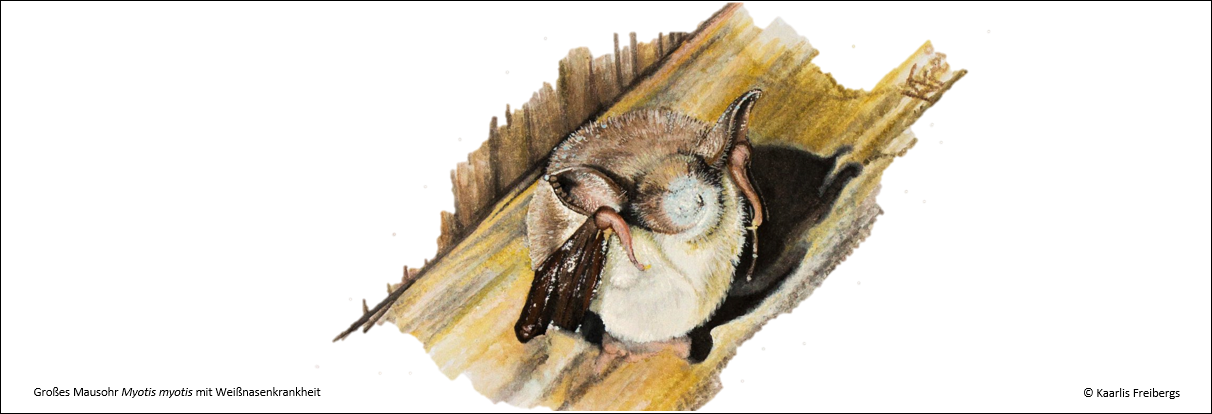
Emerging infectious diseases can become a serious threat to wildlife, a well-known example is white-nose disease, in which the cold-loving fungus Pseudogymnoascus destructans attacks bats during hibernation, penetrating the skin and causing damage. In North America, the disease has already
Federal Association for Bat Conservation Germany (BVF) questions plans of the new government with regard to the weighing of species protection in favor of wind energy
Long-term individualized monitoring of sympatric bat species reveals distinct species- and demographic differences in hibernation phenology

Hibernation allows species to conserve energy and thereby bridge unfavorable environmental conditions. At the same time, hibernation imposes substantial ecological and physiological costs. Understanding how hibernation timing differs within and between species can provide insights into the underlying drivers of
Information on bats and SARS-CoV 2 – Version 2.0 as well as recommendations for bat workers [in GERMANY]
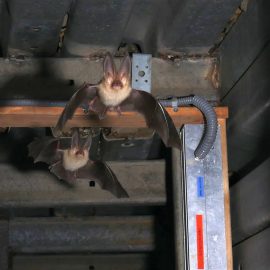
Camera traps with white flash are a minimally invasive method for long-term monitoring of bat hibernation sites
Merry Christmas and a happy new year 2022!
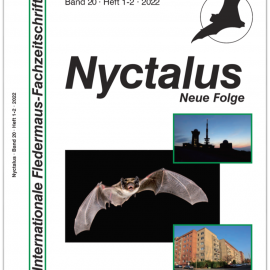
Einladung zu Fledermaus-Fachabenden am 27.01.22 und 03.02.2022 (NABU Fledermausschutz Sachsen)

Der NABU Sachsen lädt herzlich zu den ersten sächsischen Fledermaus-Fachabenden ein. Praktisch aus dem Wohnzimmer präsentieren regionale Fledermaus- und Naturschützer Ergebnisse ihrer Arbeit sowie gewonnene Erkenntnisse. Die Vorträge führen von der Landschaft des Erzgebirges bis hin zu den Plattenbauten in


![Information on bats and SARS-CoV 2 – Version 2.0 as well as recommendations for bat workers [in GERMANY] Information on bats and SARS-CoV 2 – Version 2.0 as well as recommendations for bat workers [in GERMANY]](https://www.deutsche-fledermauswarte.org/wp-content/uploads/2022/01/cover-270x270.png)